The question
In the M51–NGC 5195 interacting pair, does the soft diffuse X-ray emission along the interaction axis (PA ≈ 15.4°, from M51 toward NGC 5195) exceed what the disk's own arm-phase structure predicts at the same galactocentric radius — or is the disk emission arm-phase-dominated with no detectable tidal-axis excess
That is a single number per sub-region, repeated at three galactocentric radii inside M51's optical disk
ΔEMdisk(φaxis, ri) = EM(Bi) − EM(Ci
where Bi is a 30° wedge at PA ≈ 15.4° at radius ri from the M51 nucleus, and Ci is a conjugate wedge at the same ri in a non-axis azimuth with the same arm-phase class as Bi (arm crest, interarm, or arm-interarm boundary, from the Luan & Wang 2025 18-region log-spiral phase decomposition or the Kuntz+2016 Chandra arm/interarm mask). The vector of ΔEMdisk across i = 1, 2, 3 at r = 0.5–1.0′ / 1.0–1.5′ / 1.5–2.0′ is the azimuthal tidal-axis contrast profile
Why anyone should care
The prior family — I060, I081, I082 — asked the same question but with an estimand that lacked an origin discriminator. The B-minus-C contrast was confounded by ordinary M51 disk emission because both B and C sat inside M51's optical disk (D25) and the control had no arm-phase matching. A monotonic B-minus-C profile could arise from ordinary arm brightness decline under the same observable as the proposed "tidally displaced" or "tidally enhanced" labels
The geometric constraint is permanent: the D25 regions of M51 (semi-axes 5.6′ × 3.45′ at PA = 163°) and NGC 5195 (semi-axis 2.39′) overlap by 2.60 arcmin along PA = 15.4°. There is no radial range along the inter-galaxy axis that is outside both galaxies' D25. Deterministic geometry replay (SHA-256 c5832864…, clean-replay verified, see cycles/cycle-obs9/materials/R4_I082_terra_anchor_checks_v2.json):
| Quantity | Value | Source |
|---|---|---|
| M51 → NGC 5195 separation | 4.4102 arcmin | SIMBAD J2000, both nuclei |
| M51 → NGC 5195 PA | 15.3740° | astropy SkyCoord.position_angle |
| M51 D25 radius at PA = 15.4° | 4.6209 arcmin | D25 isophotal semi-axes 5.6′ × 3.45′ at PA = 163° |
| NGC 5195 D25 radius | 2.3946 arcmin | RC3 isophotal semi-axis |
| D25 overlap along axis | 2.6052 arcmin | sep − rD25,M51 − rD25,N5195 < 0 |
| B1/B2/B3 max projected D25 q | 0.060 / 0.135 / 0.240 | all << 1 → all inside M51 D25 |
So I091 accepts the geometric impossibility of a D25-free axial region and reframes the question. The arm-phase control is the origin discriminator: if the tidal-axis direction shows excess EM beyond what arm-phase predicts, the residual is a candidate tidal component; if no excess, disk emission is arm-phase-dominated with no detectable tidal contribution. Both outcomes move credence — TIDAL-EXCESS raises credence that tidal interactions enhance hot gas emission along the interaction axis beyond the disk's natural azimuthal structure; ARM-PHASE-CONSISTENT bounds the observable tidal contribution to the disk X-ray emission
Whose published conclusion changes the I060/I081/I082 family (cycle-obs9, R2/hermes, archived). I082's surviving R4 sub-claim was "What is the source-masked M51 disk EM contrast along PA ≈ 15.4° relative to explicitly matched disk-phase controls?" — but no arm-phase control was operative in I082. I091 makes that control operative. A TIDAL-EXCESS result would be the first arm-phase-controlled evidence for a tidal-axis-associated X-ray enhancement in a face-on system; an ARM-PHASE-CONSISTENT result would bound the tidal contribution; a MIXED/COMPLEX result would constrain single-component tidal-response models
What the measurement would look like
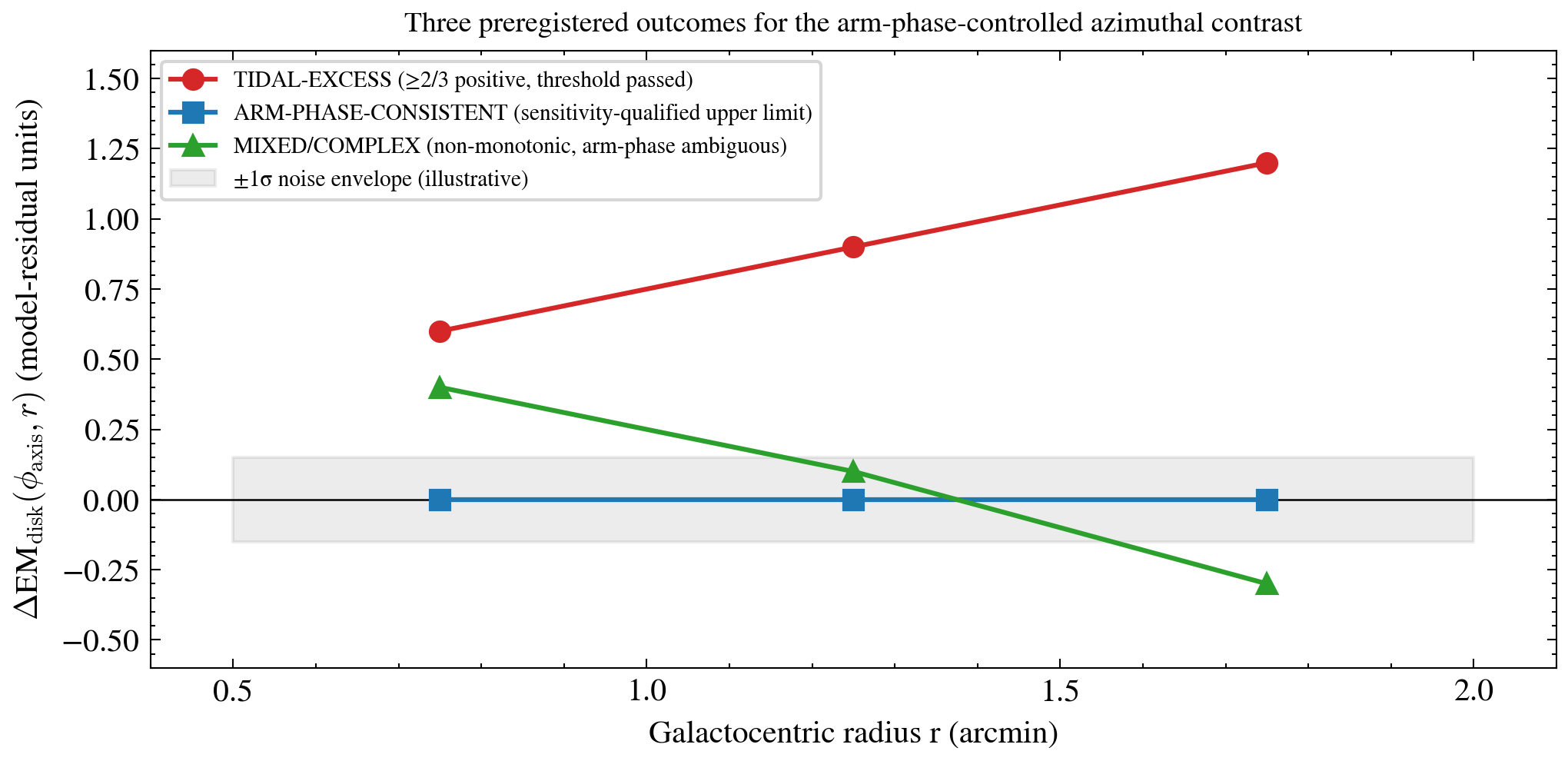
The four outcomes are MR01-compliant and mutually exclusive
- TIDAL-EXCESS — ΔEMdisk > 0 at ≥ 2 of 3 radii at the simulation-calibrated threshold, with the excess not attributable to arm-phase mismatch. Consistent with a tidally enhanced emission component along the interaction axis, beyond what the disk's arm-phase structure predicts
- ARM-PHASE-CONSISTENT — ΔEMdisk consistent with zero at all radii after arm-phase matching, or the axial direction's EM fully explained by its arm-phase class. This is a positive outcome: it bounds the tidal contribution to the disk X-ray emission above the sensitivity floor
- MIXED/COMPLEX — ΔEMdisk is non-monotonic, or significant at only 1 of 3 radii, or the arm-phase control is ambiguous (Bi sits on an arm-interarm boundary that cannot be uniquely classified). Also a positive outcome: it reports a complex/mixed morphology that constrains both classes of models
- INCONCLUSIVE — reserved exclusively for recovery-target failure: (a) E3 fails (no qualifying arm-phase-matched C at any sub-region radius), (b) E1 recovery simulation shows the contrast is not measurable at the archival depth, (c) E9 arm-phase model cannot be constructed from existing data, or (d) E8 sub-region spectral commensurability fails. A null result (no detectable excess at any sub-region, but recovery passes) is not INCONCLUSIVE — it is reported as ARM-PHASE-CONSISTENT
What it looks like if the answer comes out the other way
If the result is ARM-PHASE-CONSISTENT, the disk X-ray emission is arm-phase-dominated with no detectable tidal contribution along the axis. This is a positive outcome — it bounds the observable tidal-enhancement. It is not a boring null: it is the first sensitivity-qualified upper limit on the tidal-axis excess after arm-phase control. The bound is reported as the per-sub-region 95% CI on ΔEMdisk at the E1-calibrated sensitivity floor
If the result is INCONCLUSIVE (recovery failure), the page is honest about that. The most likely INCONCLUSIVE branch today is E9 (arm-phase model construction): the Luan & Wang 2025 annulus (45″–110″ = 0.75′–1.83′) overlaps B1/B2 but only partially B3 (r = 1.5–2.0′), so the arm-phase classification is incomplete at the outer radius. The Kuntz+2016 mask covers the full D25 but is Chandra ACIS-S, not XMM EPIC, and the cross-instrument arm-phase transfer is itself an empirical question. If E9 fails, the origin discriminator is absent and I091-G1 fails closed to INCONCLUSIVE — that is the honest answer, not a failure of the page
If the result is TIDAL-EXCESS, the symmetric-injection default for tidal interaction signatures in face-on systems is refuted at the most basic level: the arm-phase-controlled contrast shows excess emission along the interaction axis, beyond what the disk's natural azimuthal structure predicts. This constrains tidal-interaction models for hot gas enhancement in galaxy pairs. But: TIDAL-EXCESS does not prove the excess is tidally displaced gas — it could be tidally enhanced in-situ disk emission, or an arm-phase misclassification. The arm-phase control is the origin discriminator, but it is necessary, not sufficient. The RF2 firewall requires (a) excess at ≥ 2 of 3 radii surviving arm-phase control, (b) the excess exceeding the simulation-calibrated threshold, and (c) the excess not attributable to NGC 5195 halo contamination (E7 nuisance model
The honest answer is that the null is not boring — it is a sensitivity-qualified bound on the tidal-axis excess. The page is not asking for compute to discover nobody wanted the result; it is asking for compute to either measure the arm-phase-controlled contrast or bound it. Both are real results
Geometry — what the new observation looks like on the sky
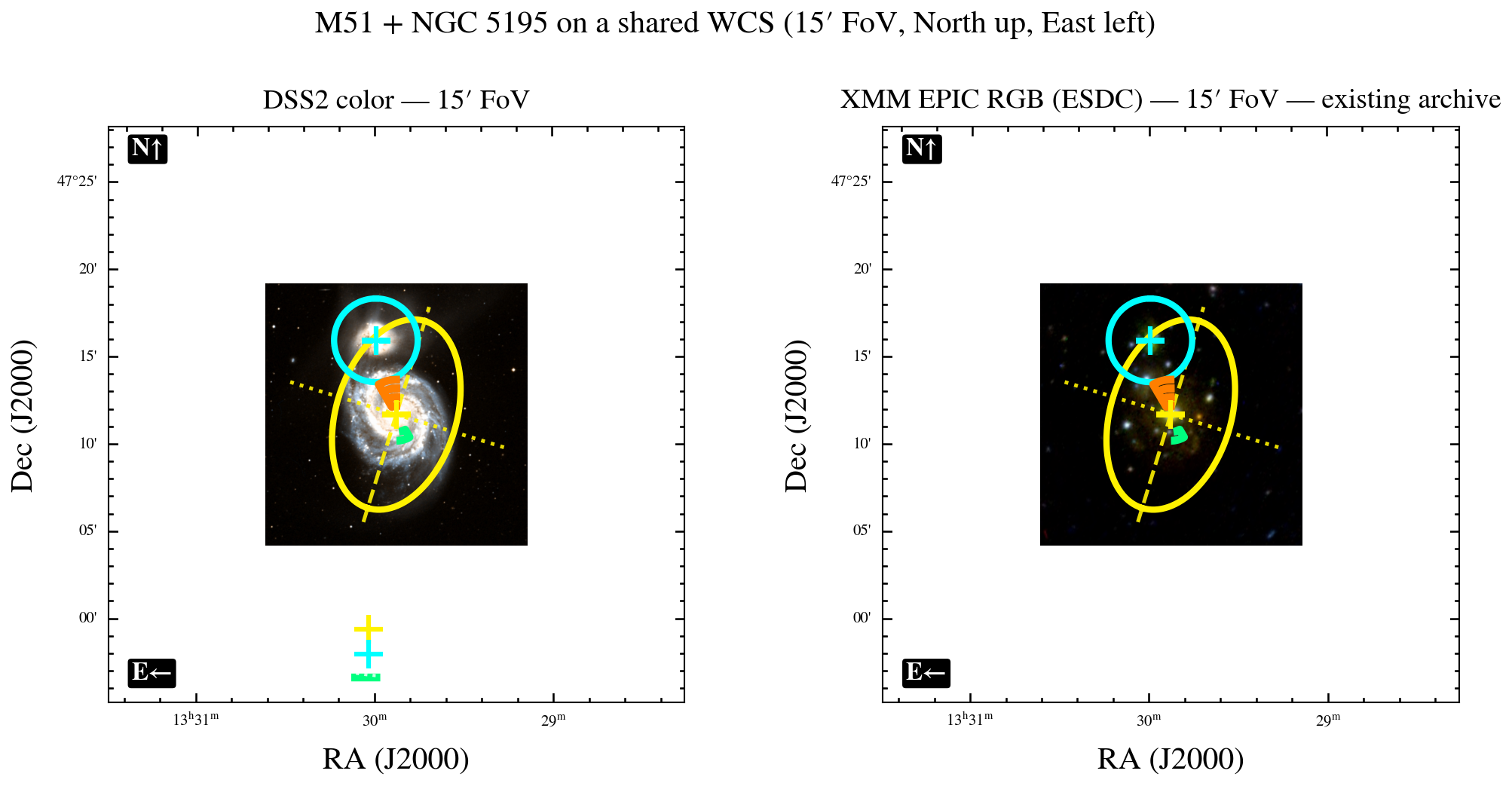
The geometry is the R4-verified permanent constraint (cycle-obs9, hermes + terra independent, SHA-256 c5832864… clean-replay verified). The Bi sub-regions are 30° wedges (±15° half-width) at galactocentric radii r = 0.5–1.0′ / 1.0–1.5′ / 1.5–2.0′ from the M51 nucleus, along PA ≈ 15.4° (the inter-galaxy axis). The Ci example shown is at the antipodal PA = 195.4° as a geometric placeholder; the actual arm-phase-matched Ci is selected by the E9 arm-phase model. The 15′ PN Full Frame FOV (white dotted circle) is the existing archival coverage — all Bi sub-regions and the Ci candidates at the same projected radii in non-axis azimuths are within nominal PN FOV geometry
Audit corrections applied inline (per the 2026-08-25 first-audit notes): East is plotted to the LEFT (astronomical convention, confirmed by the E← marker); the wedges are centred on the galaxy nucleus (galactocentric), NOT the pointing centre; the Ci example uses the antipodal PA = 195.4° (not the same PA = 15.4°); the PA→matplotlib conversion is via the WCS itself (world_to_pix), not a manual rotation. The D25 ellipses are drawn at their true PA = 163° for M51 and as a circle for NGC 5195 (semi-axis 2.39′
Why existing observations are the right starting point
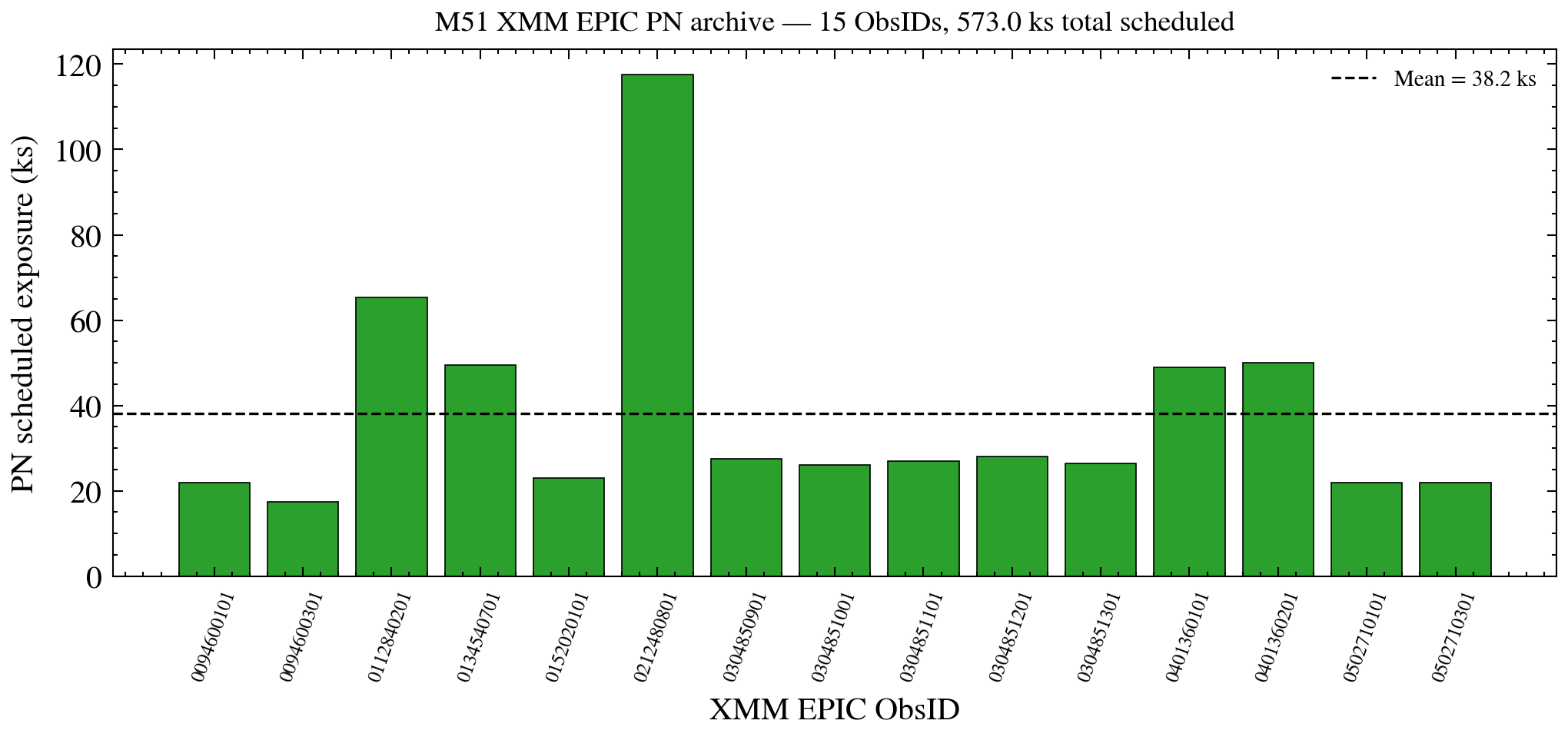
M51 has a dedicated XMM EPIC PN archive: 15 ObsIDs, ~575 ks PN scheduled (verified from R0 archive metadata). The Bi sub-regions at r = 0.5–2.0′ along PA ≈ 15.4° all fall inside the PN Full Frame FOV (15′ radius) for all 15 EPIC science ObsIDs. The arm-phase-matched conjugate Ci sectors at the same projected radii in non-axis azimuths are also within nominal PN FOV geometry
Chandra ACIS-S FOV (~8.3′) also covers the sub-regions; the Kuntz+2016 ~755 ks ACIS-S data is the primary resource for arm-phase mask definition (E9). eRASS1 has no coverage (eastern hemisphere, l = 104.85°
Track = archive the arm-phase-controlled disk contrast test is archive-first, inherited from I060/I081/I082. A new-obs request is conditional on demonstrating archive insufficiency via the E1 recovery simulation. Whether the arm-phase-controlled azimuthal contrast is measurable at this archival depth is an open empirical question (E1) — no claim that existing data are adequate or inadequate is licensed before E3/E9/E5/E1/E8 execution
What it costs — and what is still unknown about the cost
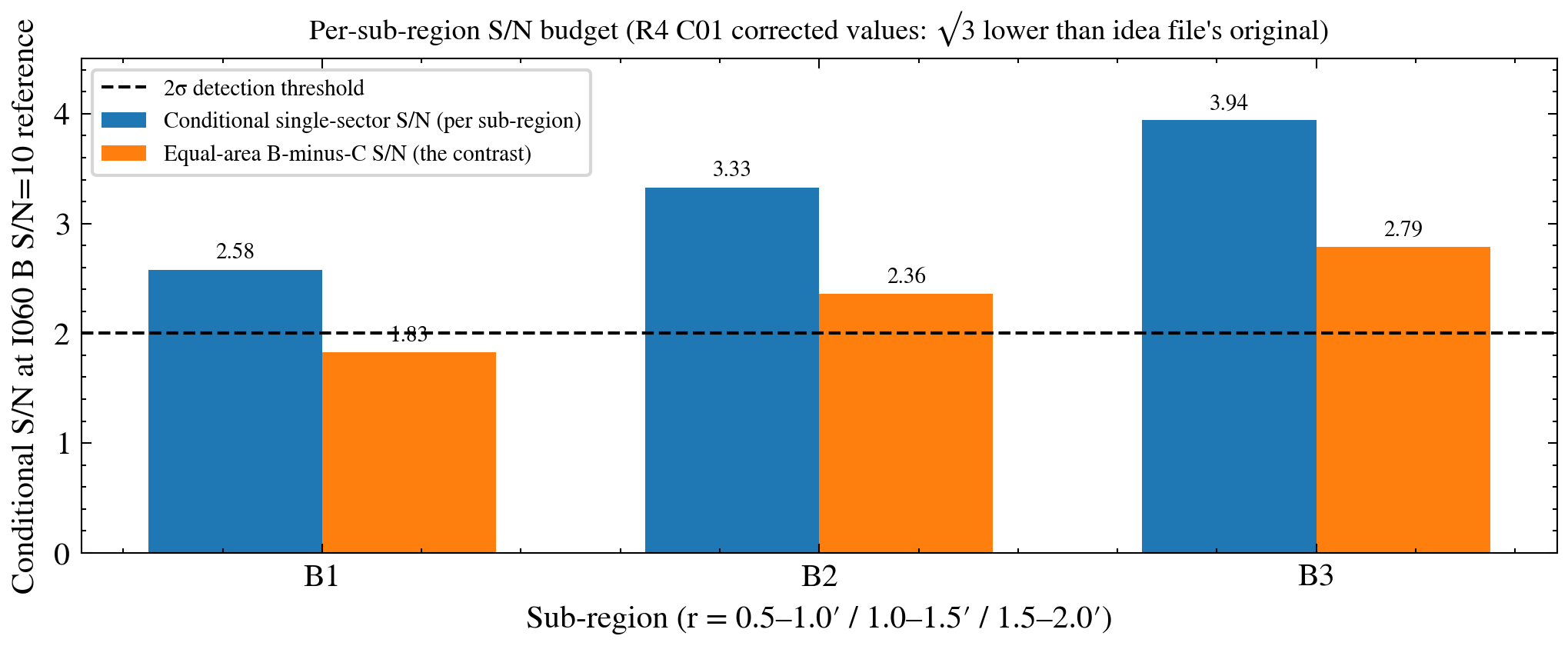
What we know: the geometry is executable (Bi sub-regions entirely inside M51 D25, verified to 4 decimals; D25 overlap along axis = 2.6052 arcmin, permanent geometric constraint). The arm-phase control is the origin discriminator that I082 lacked. The S/N budget is quantified using corrected values (R4 C01: √3 lower than the idea file's original
What we do not know: whether the arm-phase-controlled azimuthal contrast is recoverable at the archival depth. The E1 recovery simulation (response-folded, simulation-calibrated detection probability for ΔEMdisk(φaxis, r) vs injected contrast amplitude) is the load-bearing deliverable. Until E1 closes, the exposure requirement is unanchored and the measurement is conditional. The E9 arm-phase model construction (can Luan & Wang 2025 / Kuntz+2016 classify Bi and Ci into arm-phase classes at r = 0.5–2.0′?) is the second load-bearing deliverable. If E9 fails, the origin discriminator is absent and I091-G1 fails closed to INCONCLUSIVE
What it costs (archive-first): zero new XMM time. The cost is the HEAVY R6 work for E3/E9/E5/E1/E7/E8 — the archive-adequacy demonstration, the arm-phase model construction, the contrast-recovery simulation, the sub-region spectral commensurability check, and the joint S/N5195 domain separation. The arm-phase control adds new empirical requirements beyond I082's: E3 (outcome-blind azimuthal D25 survey at each sub-region radius with arm-phase classification of each candidate Ci), E9 (arm-phase model construction), E5 (same-∇EMdisk event-level archive extraction from B1/B2/B3 and arm-phase-matched C1/C2/C3 regions), E1 (response-folded contrast-recovery simulation at corrected S/N), E8 (sub-region spectral commensurability
Gate ledger (D043 — single source of truth
| Gate | Status | Role |
|---|---|---|
| I091-G1 | OPEN | D25-geometry-successor fork of I082 with arm-phase-controlled disk azimuthal contrast. RF2 interpretation firewall: TIDAL-EXCESS requires excess surviving arm-phase control + threshold + NGC 5195 halo exclusion; ARM-PHASE-CONSISTENT is a positive outcome (bounds tidal contribution); MIXED/COMPLEX is a positive outcome. E2/E4/E5/E6 inherited from I060/I081/I082 (axis- and sub-region-independent). E3 re-specified for arm-phase-matched control availability. E9 added for arm-phase model construction. E1 re-specified for contrast recovery at corrected S/N. E8 retained for sub-region spectral commensurability. All numerical values EMPIRICAL/needs-data |
| E2 (inherited | FROZEN | No defensible sourced EMref in literature; WEAKEN permanently unavailable. Axis- and sub-region-independent |
| E3 (re-specified | OPEN — EMPIRICAL | Outcome-blind azimuthal D25 survey at rB1 = 0.75′, rB2 = 1.25′, rB3 = 1.75′ on corrected geometry. Ci exclusion axis = PA ≈ 15.4° (tidal axis). Candidate Ci at each radius must have (a) no NGC 5195 overlap, (b) the SAME arm-phase class as Bi (arm crest / interarm / boundary), (c) no SF complexes. Fail-closed per sub-region: if all three Ci fail, contrast non-identifiable → INCONCLUSIVE. HEAVY R6 |
| E4 (inherited | FROZEN | N5195(B) nuisance-model form = additive APEC + powerlaw, free norm, no shape borrowing from B, Kuntz+2016 sources excised. Applied per sub-region. Axis- and sub-region-independent |
| E5 (inherited | FROZEN (scope | Kuntz D25 product disqualified; same-ΔEMdisk archive test requires frozen B1/B2/B3 + operative estimand. Exact polygon EMPIRICAL/R6 |
| E6 (inherited | FROZEN — NEEDS-DATA | R3 literature path closed (9 ADS query families exhausted). WEAKEN unavailable. Axis- and sub-region-independent |
| E1 (re-specified | OPEN — EMPIRICAL | Contrast-recovery simulation at corrected S/N (B1 = 2.58, B2 = 3.33, B3 = 3.94 at I060 B S/N = 10 per R4 C01; equal-area B-minus-C: 1.83 / 2.36 / 2.79). EM = APEC norm → EM via T74 distance-scaled volume (d ≈ 8.6 Mpc). Recovery = simulation-calibrated detection probability for the azimuthal contrast ΔEMdisk(φaxis, r) vs injected contrast amplitude. Coverage = calibrated 95% CI. Adequacy = ≥ 50% recovery of the contrast sign at frozen scale using actual clean exposure. Filter-specific response (0212480801 MEDIUM vs THIN1). HEAVY R6 |
| E7 (re-specified | OPEN — EMPIRICAL | Joint S (signal sub-regions B1/B2/B3) and N5195(B) domain separation on corrected geometry. N5195(B) is outside D25 for all sub-regions (B3 at 2.66′ from NGC 5195, outside D25 radius 2.39′), so the N5195 halo contribution is a nuisance. Response/PSF/vignetting covariance per sub-region. HEAVY R6 |
| E8 (retained | OPEN — EMPIRICAL | Sub-region spectral commensurability: B1/B2/B3 and C1/C2/C3 must be response-folded on a common energy/response basis. The sub-regions span different vignetting/PSF/effective-area regimes; per-sub-region ARF/RMF differences must be quantified and either corrected or shown to be sub-dominant to the contrast signal. HEAVY R6 |
| E9 (new | OPEN — EMPIRICAL | Arm-phase model construction: can the Luan & Wang 2025 18-region log-spiral phase decomposition (T254) and/or the Kuntz+2016 Chandra ACIS-S arm/interarm mask (T143) be used to classify Bi and Ci into arm-phase classes at r = 0.5–2.0′? The Luan & Wang annulus (45″–110″ = 0.75′–1.83′) overlaps B1/B2 but only partially B3 (r = 1.5–2.0′). The Kuntz+2016 mask covers the full D25. The arm-phase model must be frozen before E3 control selection. If the arm-phase model cannot be constructed, the origin discriminator is absent and I091-G1 fails to INCONCLUSIVE. HEAVY R3/R6 |
What I am and am not claiming
I am claiming the science question is real (tidal interactions in face-on galaxy pairs are a load-bearing belief in subgrid-feedback recipes and the arm-phase-controlled contrast is the missing origin discriminator); the geometry is constrained (Bi sub-regions entirely inside M51 D25, D25 overlap along axis = 2.6052 arcmin, permanent geometric constraint); the arm-phase control is the origin discriminator that I082 lacked; the S/N budget is quantified using corrected values (R4 C01: B1 = 2.58, B2 = 3.33, B3 = 3.94 at I060 B S/N = 10); and the E9 arm-phase model construction is the load-bearing empirical deliverable
I am not claiming that
- A TIDAL-EXCESS result would prove the excess is tidally displaced gas — it could be tidally enhanced in-situ disk emission, or an arm-phase misclassification. The arm-phase control is necessary, not sufficient (RF2 firewall
- An ARM-PHASE-CONSISTENT result would prove there is no tidal contribution — it bounds the observable contribution above the sensitivity floor
- One galaxy can "validate" a population-level or cosmological prescription — I091 constrains this galaxy, this epoch, this projected scale, this phase, at this precision
- The arm-phase control is tautologically circular — the R4 third-pass REFRAME (arm-phase = EM class per Luan & Wang 2025, so the control matches the same variable that the contrast measures) is preserved as a NOTE in the R5 adjudication; the arm-phase control is a model-residual characterization, not an origin discrimination in the strict causal sense. The I091 estimand is the EM residual after subtracting an arm-phase EM model from the tidal-axis direction
- The 15′ PN Full Frame FOV circle is response/extraction feasibility — it is nominal circular containment, not detector footprint, CCD gaps, vignetting, usable exposure, or off-axis response. Those are E1/E8 EMPIRICAL
- The existing archive is adequate or inadequate for the contrast — that is the E1 recovery simulation's job
Why this page exists
I091 is currently parked_hold per the cycle-obs9 R5 adjudication (cycles/cycle-obs9/r5_adjudication_i091.md, 2026-08-11). The hold is routing, not acceptance of an R4 scientific verdict: I097 is the already-executed active redesign successor and routes to R2 new_idea. The original I091 design stays recoverable as a fully recorded lineage node. The page is the artifact that makes the I091 judgement possible — what the question is, why anyone should care, what the measurement would show, and what it would look like if the answer came out the other way
HEAVY is paused (PI, 2026-08-23). An idea does not reach compute by asking for it — it reaches compute by being written up as a page the PI reads and approves. This page is that artifact for I091
Provenance
- Idea file:
shared/ideas/I091_m51-disk-azimuthal-tidal-axis-contrast-fork.md - R2 Admission:
cycles/cycle-obs9/r2_admission_i091_fork.md(cycle-obs9, hermes, 2026-08-09 - R5 Adjudication:
cycles/cycle-obs9/r5_adjudication_i091.md(cycle-obs9, 2026-08-11, status: audited-parent-hold - R4 Geometry anchor:
cycles/cycle-obs9/materials/R4_I082_terra_anchor_checks_v2.json(SHA-256c5832864471166b704e520eb3be6cd7dc62235a6443d5c2a7db9cd9d417ced5b, clean-replay verified - R4 Second-anchor (LandW coverage):
cycles/cycle-obs9/materials/R4_I091_hermes_second_anchor.json(SHA-256e7d838a928601fe2b541774012d1fda9140f7456039f62aca79796376c861eeb, clean-replay verified - Luan & Wang 2025 source card:
shared/sources/papers/Luan+Wang_2025.md - SIMBAD coordinates (M51 + NGC 5195):
cycles/cycle-obs9/materials/R4_I012_simbad_coordinates_20260807.json(SHA-256069c857accad0297899e508263b49ef1e007107e9757c3357806d153254e08c1 - Figure provenance:
fig/fig1_provenance.json(geometry, S/N, WCS, all numerical values - HiPS2FITS source FITS:
CDS/P/DSS2/colorandESDC/P/XMM/EPIC-RGB, fetched 2026-08-25 fromhttps://alasky.cds.unistra.fr/hips-image-services/hips2fits(fov = 0.25° = 15 arcmin, 1024×1024, ICRS
Geometry replay command (used to compute D25 overlap and sub-region max-q):
python3 cycles/cycle-obs9/r4_i082_terra_anchor_checks.py --output /tmp/r5_i091_i082_anchor_replay_20260811.jsonResult: M51→NGC 5195 PA = 15.374°; all I082 sub-regions inside projected M51 D25 (max-q B1 = 0.060, B2 = 0.135, B3 = 0.240); D25 overlap along axis = 2.605 arcmin. Conditional single-sector S/N at I060 B S/N = 10: B1 = 2.58, B2 = 3.33, B3 = 3.94 (R4 C01 corrected